|
Collision course
|
||
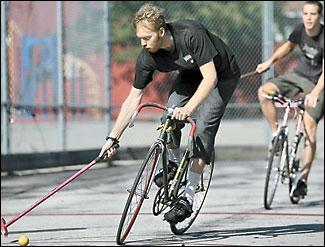
| Those thrill-seekers known as bicycle couriers mount their two-wheelers and take up mallets in the spirit of competition - and helping their own. Philadelphia Inquirer, October 21, 2005 By Rob Watson Saturday morning, as most of us are giving weary thanks for a couple days' rest, hard-core men and women with two-wheeled steeds will await the rules of battle. The theater: the roller-hockey rink at Northern Liberties' Tip Top Park at Front and Allen Streets. The campaign: the first-ever bicycle-polo tournament held by Philadelphia bike messengers - the Philly Bicycle Messenger Association East-Side Polo Invite: Death and Glory.
Sure, the title of this two-day event sounds a bit dire, but don't be fooled. The players are in it for some good, clean fun. And while the game can be brutal, this weekend there's a great cause mixed in with the mayhem, according to Corey Hilliard, owner of Vespid Productions courier service and the tournament's organizer. "Most couriers don't have health insurance, so some of the proceeds will go towards BMEF, the Bicycle Messengers Emergency Fund," Hilliard said. "It's an international nonprofit organization to help couriers injured on the job." Another portion will go toward preparing for the North American Courier Cycling Championships, which will be held in Philly next June. Not familiar with bicycle polo? To the uninitiated, it looks like a recipe for disaster. At least six (there are usually three people per team) mallet-wielding gladiators on bikes, often sans helmets, chase a roller-hockey ball toward opposing goals on a small rectangle of concrete. During the players' weekly pickup games on Wednesdays at Markward Park at Taney and Pine Streets, slings and hard casts seem inevitable, considering the potential for falls and collisions. But what emerged out of this weekly game of urbanized bike polo was some semblance of grace - and plenty of skill - among the competitors. (It's a good thing, too, considering these two-wheelers would be of no use transferring the wounded.) That's not to say this is ballet; contact, with each other and the ground, does happen. "People crash, get a little bloody, bikes get ruined, but no one takes it to heart," said Santana Bonilla, a custom bike-painter and player. "You're not trying to hurt someone, you're trying to win." The notion of playing polo on bicycles is believed to have been started by India-based British troops looking to keep their equestrian skills sharp, according to the U.S. Bicycle Polo Association. The invention of the game is credited to an Irishman, Richard J. Mecredy, back in 1891. Later brought to these shores by Irish immigrants, the official game of two teams of four playing on a grass pitch slightly larger than a football field has been played in the States for more than 100 years. The NACCC has played this faster, smaller urban version, which favors blacktop instead of natural surfaces, for a few years. The game has only a few similarities to the wide-open game of its older brother: Your feet can't leave the pedals during play, and the mallet must be used to advance the ball (called shuffling) up the field of play and into the goal. In the grass game, players must use only the right hand to wield the mallet (PhillyBMA's game holds no grudges against southpaws); the game is played in four, 10-minute "chukkars," or quarters (teams will play 10-minute games in Saturday's event); and there are all kinds of right-of-way restrictions that bike messengers have never had any use for, either in their day jobs or this sport. "The official game is kind of slow and all the official rules are boring, so we adapted that game to the street surfaces we ride on every day," Bonilla said. John Kennedy, a 10-year bike-polo vet and director of operations for the U.S. Bicycle Polo Association, is the keeper of those official rules, but is all for any tournament that gets the word out. "We would like them [players] to be wearing helmets. That being said, we have got people playing with PVC pipes, croquet mallets, and using studded tires for ice rink matches," Kennedy said. "We just want people to play and be seen playing. Passersby always stop to see exactly what's going on, and it's hard not to want to try it out after a couple of minutes." While there will be mallets available for newcomers, cyclists who intend to step into the rink Saturday are warned to leave any machinery they hold dear at home. To help out, the Cutthroats, a team from Richmond, Va., is bringing an army's worth of cheap bikes - 69, if all goes according to plan. The order of the day will be surviving, not showing off. "Just bring cheap bikes that can take a beating," courier and bike mechanic James "J.P." Guterl said. "Maybe a couple of extra front wheels if you can, as they get the worst of it." |